Why Standard Bandsaw Blades Fall Short on Case Hardened Steel
There’s a specific kind of frustration that comes from watching a blade that works perfectly on mild steel fail within the first few cuts on case hardened material. It doesn’t feel like the blade is doing anything wrong, it’s running at the right speed, the setup looks correct, and then the teeth are gone. That experience is common enough that it points to a systematic issue rather than operator error. Case hardened steel is manufactured to be wear-resistant at the surface, and a bandsaw blade is a cutting tool that succeeds by wearing away the material it contacts. When the material surface is harder than the tooth material, or when the heat generated at the contact zone exceeds what the tooth can handle, the blade loses every time. Solving the problem starts with accepting that case hardened steel requires a blade selected specifically for its properties, not a blade that happens to be available or already mounted on the machine.
Understanding the Material Before Selecting the Blade
The right blade for case hardened steel follows directly from understanding what happens at the cut zone during each pass. Case hardened steel is not a single uniform material, it’s a composite structure with a hardened outer layer produced by carburizing, nitriding, or induction hardening, sitting over a tougher, more ductile core. That structural difference creates a set of cutting conditions that wear blades in ways that solid homogeneous steels do not. Knowing these conditions in advance makes blade selection straightforward rather than a process of trial and error:
- A surface hardness layer that can reach 60 HRC or higher, putting it well beyond the range where standard bi-metal teeth hold up
- Extreme abrasiveness at the outer skin that rapidly strips tooth geometry even when the blade initially cuts without resistance
- Heat that builds quickly at the contact zone because the hardened surface resists penetration and forces the tooth to work harder for each increment of depth
- Hardness transitions at the case-to-core boundary that create sudden changes in cutting load and increase the risk of tooth chipping
- Susceptibility to work hardening when blade speed or feed rate drops, which compounds the difficulty mid-cut
- Repeated impact on round and tubular profiles as the blade tooth crosses the hardened outer layer on entry and exit
Why Blade Material Matters More on Case Hardened Steel Than on Standard Alloys
On mild steel or low-alloy structural shapes, blade material selection has a real but moderate impact on blade life and performance. On case hardened steel, it becomes the deciding factor between a blade that lasts and one that fails before finishing a single cut. The reason comes down to what happens to tooth hardness under heat. A standard M42 cobalt bi-metal blade holds its edge well under normal metal cutting conditions, but the hardened surface of case hardened steel generates enough localized heat to begin degrading that edge faster than it wears on softer materials. Carbide, by contrast, maintains its hardness through temperature ranges that would compromise any high-speed steel grade. The micro-grained carbide inserts used on the best bandsaw blades for case hardened steel are brazed to a fatigue-resistant backing steel that keeps the blade structurally intact through the mechanical stress of continuous bandsaw operation. That combination of sustained tooth hardness and backer durability is what makes carbide the technically correct choice for high-hardness case hardened steel rather than simply the expensive one.
The Qsaw 1002 CT Triple Chip Carbide: Purpose-Built for the Hardest Cutting Conditions
The Qsaw 1002 CT Triple Chip Carbide Bandsaw Blade from Sawblade.com was not designed to be a general-purpose blade that happens to cut hard materials. It was built from the ground up for aerospace, foundry, and high-production environments where materials like Inconel, titanium, martensitic stainless steel, and high-nickel alloys are the daily workload. Case hardened steel fits squarely within that application range. The triple-chip grind geometry distributes cutting load across alternating tooth heights and bevel profiles, which manages chip formation and heat generation far more effectively than a standard alternating-set pattern. Micro-grained carbide teeth mounted on a reinforced fatigue-resistant backing give the blade the edge retention and structural integrity to maintain performance through production volumes where bi-metal blades would need frequent replacement. Every blade is custom welded to order, built to the exact length, width, and TPI that the application requires.
Side-by-Side: How the Sawblade.com Lineup Stacks Up for Case Hardened Steel
| Specification | Qsaw 1002 CT Triple Chip Carbide | Qsaw 701 M71 Bi-Metal | Qsaw 601 M42 Bi-Metal |
|---|---|---|---|
| Tooth Material | Micro-grained carbide (brazed tips) | M71 cobalt HSS, ground tooth | M42 cobalt HSS, ground tooth |
| Tooth Hardness | Carbide (~90 HRA) | HRC 70 | HRC 67-68 |
| Tooth Geometry | Triple-chip grind, positive rake | Variable height, aggressive rake | 5-7° positive rake |
| Primary Applications | Case hardened steel, titanium, Inconel, high-nickel alloys | Case hardened steel, D2, Inconel, Monel, stainless, nickel alloys | Carbon steel, chrome steel, die steel, tool steels, stainless |
| Best For (Shapes) | Round/square bar, tube, bundle cuts | Round/square/rectangle bar and tube | All shapes, horizontal and vertical saws |
| Key Benefits | Maximum blade life, fast cutting, clean finish | Faster than M42 on hard alloys, lower cost than carbide | All-purpose versatility, cost-effective |
| Production Type | Custom welded to order | Custom welded to order | Custom welded to order |
| Available At | Qsaw 1002 CT | Qsaw 701 M71 | Qsaw 601 M42 |
Where the Qsaw 701 M71 Fits in the Case Hardened Steel Conversation
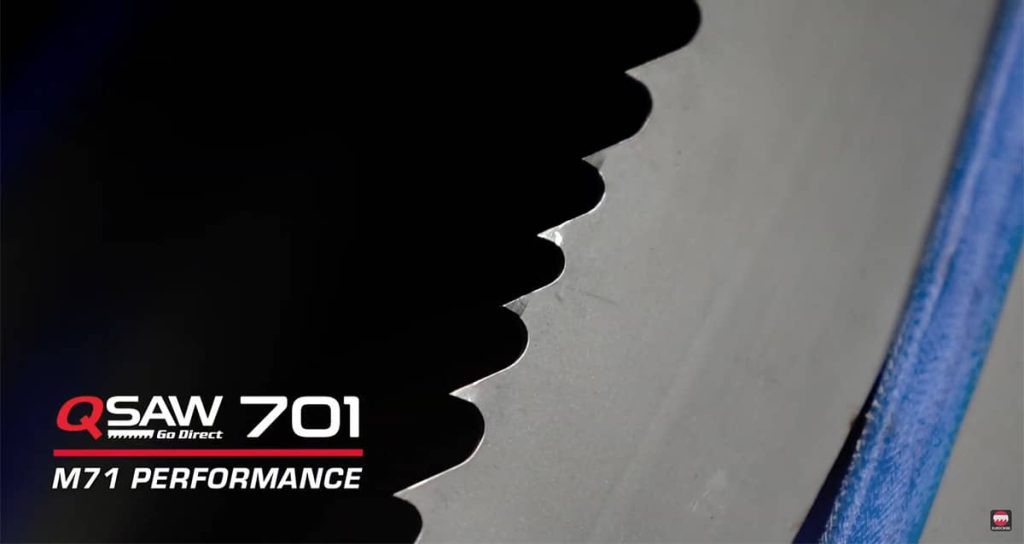
The Qsaw 701 M71 Bandsaw Blade from Sawblade.com occupies a position that matters a great deal to shops cutting case hardened steel alongside other difficult alloys. Its M71 cobalt high-speed steel edge is ground to HRC 70, which gives it a meaningful hardness advantage over M42 grades without crossing into carbide territory on price. The variable-height ground tooth design generates a pulsating cutting action through the material that handles the surface hardness and work-hardening behavior of case hardened steel, D2 tool steel, Inconel, Monel, and nickel-base superalloys more effectively than any fixed-geometry bi-metal blade. Shops that find M42 blades wearing too fast on their harder work but aren’t ready to move the entire operation to carbide will find the 701 closes that gap in a practical and cost-effective way. It consistently delivers faster cutting rates and longer blade life on difficult materials than M42 alternatives, which translates directly to lower cost per cut over time.
When the Qsaw 601 M42 Remains a Viable Option
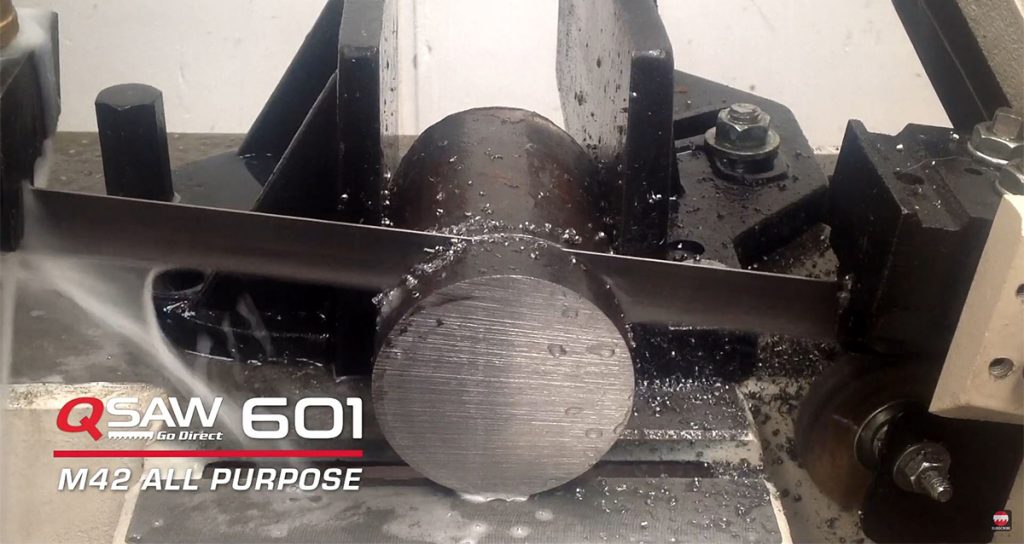
The Qsaw 601 M42 earns its place in the lineup by being genuinely capable across a wide range of steel types, and case hardened steel is not automatically beyond its reach. If the surface hardness of the components being cut sits in the moderate range, the sections are not excessively large, and the shop environment mixes case hardened work in with structural steel, stainless, and general fabrication, the Qsaw 601 M42 Bi-Metal from Sawblade.com delivers solid performance without requiring a dedicated blade for each material. Its M42 cobalt edge with a 5-7 degree positive rake angle gives it better thermal resistance than standard bi-metal grades, and the engineered alternating tooth pattern reduces the vibration and chatter that case hardened material tends to amplify. For shops at the beginning of working out the right blade for their case hardened applications, the 601 is a reasonable entry point that provides useful performance data before committing to a higher-specification blade.
The Criteria That Separate Good Blade Choices from Poor Ones
Narrowing down the right bandsaw blade for case hardened steel is easier when the evaluation is structured around the factors that actually determine performance rather than brand familiarity or price alone. Each of these criteria has a direct effect on how the blade behaves in contact with a hardened surface, and ignoring any one of them creates a predictable failure mode:
- Tooth material hardness retention under heat, which is the single most important factor when cutting a material that generates sustained thermal load at the contact point
- Rake angle geometry, since the angle at which the tooth enters the material determines how efficiently it shears versus how much it scrapes and drags
- Backing steel fatigue resistance, because the backing flexes continuously around the bandsaw wheels and must maintain integrity over the full service life of the teeth
- TPI matched to the cross-section being cut, since case hardened steel in larger solid sections requires a different tooth pitch than thin-wall tube or small-diameter bar
- Tooth set design and vibration damping, which become especially important when the blade is crossing the hardness boundary between the case layer and the softer core
- Weld joint quality, since a blade that fails at the weld after minimal use indicates a manufacturing issue rather than a cutting issue and skews any performance assessment
How Tooth Geometry Determines Blade Behavior on Hard Surface Materials
Every tooth on a bandsaw blade performs a small, repeating cycle: it contacts the material, penetrates, forms a chip, and exits. On case hardened steel, that cycle is harder on the tooth than on most materials because the entry phase requires breaking through a surface that actively resists penetration. How the tooth geometry is designed to handle that moment determines how quickly the blade wears and how much heat it generates doing it. The Qsaw 1002’s triple-chip grind staggers tooth height and introduces bevel angles that distribute the cutting load across different tooth profiles, preventing any single tooth shape from absorbing the full impact of the hardened surface on every pass. The Qsaw 701 M71 uses a different approach with its variable-height ground tooth geometry, creating a pulsating action that prevents the uniform pressure buildup that causes work hardening and heat concentration at the cut zone. Both solutions reflect the same underlying principle: purposeful tooth geometry designed for hard and abrasive materials outperforms general-purpose geometry adapted to work outside its original design parameters.
What Blade Failure Patterns Reveal About the Root Cause
Blade failures on case hardened steel are rarely random. The way a blade fails carries information about whether the problem is the blade itself, the setup, or the cutting parameters, and reading those patterns correctly is what gets the issue resolved efficiently rather than replaced repeatedly without improvement. These are the failure signs most directly associated with an incorrect blade selection for case hardened steel:
- Edge rounding or tooth profile loss after only a small number of cuts, which points to a tooth material that can’t sustain hardness at the temperatures the material generates
- Bluing or heat tint on the blade body adjacent to the cut zone, indicating that the tooth isn’t clearing heat fast enough through the chip
- Lateral drift in the cut that worsens progressively, caused by uneven tooth wear that pulls the blade off the cut line
- Audible chatter or resonance when the blade contacts the outer layer of round or square case hardened profiles
- Surface finish degradation through the cut session, going from acceptable early cuts to torn or rough faces as the teeth lose their geometry
- Early weld joint failure under moderate loads, pointing to a blade not rated for the stress levels case hardened steel puts on the backing
What Sets Sawblade.com Apart for This Type of Application
Sourcing a bandsaw blade for case hardened steel from Sawblade.com means working with a supplier that custom welds every metal cutting blade to the exact dimensions of the machine running it. Length, width, thickness, and TPI are all specified at order, which eliminates the performance compromise that comes with adapting a near-size blade to a machine it wasn’t built for. The practical side of that matters most when a blade needs replacing quickly: orders placed before 2:30 PM CST ship the next business day, so a production line running case hardened steel isn’t waiting several days for a replacement blade built to the right spec. The team’s background in machining and production environments also means that questions about blade selection for specific materials and applications are answered from experience rather than from a product sheet, which makes a real difference when the application is something outside standard carbon steel cutting.
Also Read the BS100 Bandsaw Guide
If you are looking for more bandsaw setup and maintenance information, the article “BS100 Guide: Manual, Blade Size, Parts, and Common Fixes” is a useful related read. It covers helpful details for the BS100 bandsaw, including where to find the manual, what blade size to use, common replacement parts, and practical fixes for issues owners may run into. It is a good next step for readers who want model-specific guidance before adjusting, repairing, or maintaining their saw.
Products from Sawblade.com to Consider for Case Hardened Steel Cutting
The blade is the starting point, but the full setup matters. These products from Sawblade.com support reliable performance on case hardened steel and other hard alloy applications:
- Qsaw 1002 CT Triple Chip Carbide — the correct choice for high-hardness case hardened steel, production volumes, and any application involving Inconel, titanium, or martensitic stainless where bi-metal blades consistently fall short
- Qsaw 701 M71 Bi-Metal — the best bi-metal option for case hardened steel and exotic alloys, with HRC 70 tooth hardness and variable-height ground geometry that outperforms M42 on difficult materials
- Qsaw 601 M42 Bi-Metal — suited to moderate-hardness case hardened work and mixed-material environments where a single versatile blade handles most of the shop’s cutting requirements
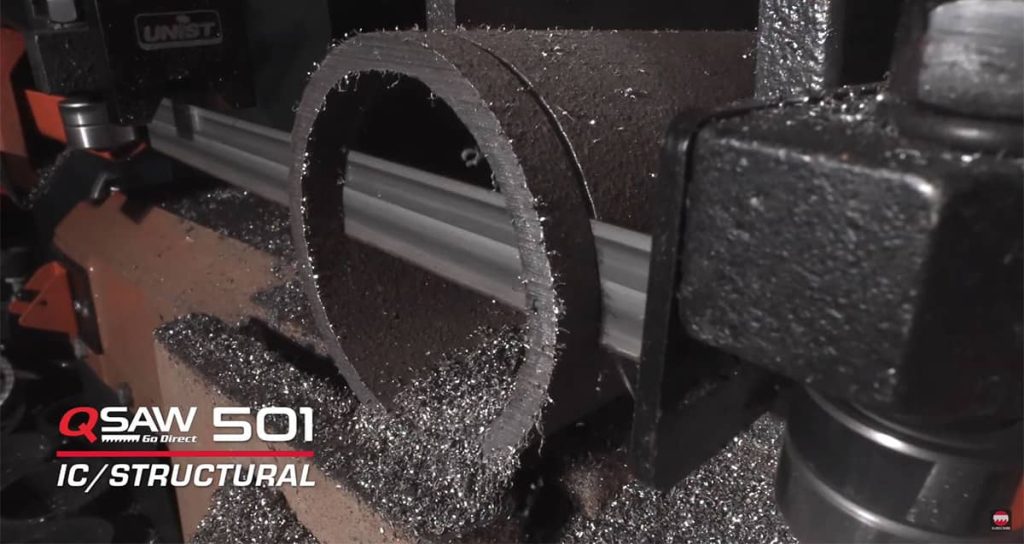
- Q501 IC M42 Wide Set Blade — the right blade for structural steel sections and bundle cutting where chip clearance and tooth protection under vibration are the governing requirements
- Cutting fluid from Sawblade.com — consistent flood cooling from the start of the cut to the finish reduces the thermal load on every blade type and extends service life measurably on hard materials
- Bandsaw blade brushes — chip clearance between cuts is a simple but effective way to reduce recutting and heat accumulation, particularly on abrasive materials like case hardened steel
Getting Full Value from the Right Blade
A blade matched correctly to case hardened steel still needs to be run correctly to deliver the blade life and cut quality it’s capable of. Surface feet per minute is the variable most often set incorrectly: carbide blades and high-performance bi-metal grades on hard materials run slower than general-purpose blades on mild steel, and operators accustomed to running faster speeds will shorten blade life significantly by not adjusting downward for the material. Feed pressure also needs to be calibrated to the material, with particular attention at the start of a new blade’s service life where the teeth are most vulnerable to micro-chipping under aggressive loading. Cutting fluid should be applied as a continuous flood throughout the cut, not just at the beginning or intermittently. Guide adjustment is worth checking before each session to confirm the blade is supported without friction that adds to the heat budget. When blade selection, speed, feed, cooling, and guide setup are all aligned, the cost per cut on case hardened steel drops to a level that makes the application routine rather than a source of ongoing maintenance problems. Sawblade.com’s team is reachable at 800.754.6920 for anyone working through the selection process for a specific machine, material, or production requirement.